

Collector Stories: The 45 That Started It All
We hear from a lot of collectors, but every so often a story comes in that stops us. This one came from Danny D, a WickerWoodWorks customer since 2019. Danny's collection lives in an Elliott, several Deluxes, a stack of Cubes, and three custom pieces we built for him. It starts with a Beatles 45 in a Bellevue drugstore in 1964, and we are running it in his words.
That is his actual copy in the photo above, with DANNY written across the label in marker by a six-year-old who wanted everyone to know whose record it was.
I started collecting records when I was six years old, buying my first 45 at Lake Hills Drugstore in Bellevue, Washington. That's where you went looking for records when I was a kid. A few nights before, like many people, I saw the Beatles on Ed Sullivan, and when they did this song, even as a six-year-old, it blew my mind. I had to have the 45, and I still do. Granted, it's not in great shape, but who knew it would be something I'd still wanna listen to 60 years later?
As a kid, and for a few years after, I didn't even realize that anybody else had done this song. It was so primal, like nothing I'd ever heard before. Of course, it was a cover of the Isley Brothers' song, which is an amazing version as well.
The cool thing about 45s is that there's a song on both sides. In this case, the song is called “There's a Place.” A completely different kinda song than “Twist and Shout,” but a lyric that to this day strikes a chord with who I am. It speaks of the place you need to be able to go to when things are just not going right. Metaphorically, or in reality, there are those days. Sometimes, even now, when I need to go to that place, I can put on this song and instantly be transported. That's the magic of music!
Why the First Record Never Leaves the Collection
Ask almost any collector about their first record and you will get a specific answer. They remember the store, the price, who they were with, and what the sleeve looked like. Collections grow into the thousands and that one 7-inch single still gets its own spot.
There is a practical reason for that beyond sentiment. A first record is usually the most played and the worst stored, because nobody hands a six-year-old an archival sleeve. It gets carried around, stacked, left out, and in Danny's case signed in permanent marker. Sixty years later it is scuffed and noisy and completely irreplaceable, which is exactly why it deserves better storage now than it got then. I grew up in the era of cds. I still have most of my collection but missing cases, inserts and heavy scratches are riddled throughout.
What Is a 45, and Why Do Collectors Still Buy Them?
A 45 is a 7-inch single that plays at 45 revolutions per minute, usually with one song per side. Through the 1950s and 60s it was how most people bought music. You did not buy the album, you bought the song, and it cost pocket change.
Collectors still chase them for a few reasons. Singles were often pressed with different mixes than the album version. They carry the original artwork and label design of a specific release and pressing. And they are still one of the most affordable ways into collecting, which makes them a good starting point if you are building a collection from nothing.
What Is a B-Side?
Every 45 has two sides. The A-side is the song the label was pushing, the one meant for radio. The B-side is whatever went on the back, and that is where things get interesting.
Sometimes a B-side was filler. Sometimes it was a song the label did not know what to do with, and it turned out to be the better track. Collectors have been finding those for decades, and it is a real part of why the format is still worth digging through. You cannot skip past a B-side the way you scroll past a track. You have to flip the record over, which means you actually hear it.
Danny's B-side is a good example. “There's a Place” was never the hit, but it charted on its own at number 74, and Lennon described it as his attempt at writing something in the Motown style. Sixty years later it is the side Danny reaches for.
Who Actually Wrote “Twist and Shout”?
Look closely at the label on Danny's copy and it reads “(Medley-Russell).” That is Phil Medley and Bert Berns, who published under the name Bert Russell. They wrote the song in 1961 under a different title, “Shake It Up, Baby,” and it was first recorded by the Top Notes.
It did not become a hit until the Isley Brothers covered it in 1962, which is the version Danny is talking about and the one the Beatles were working from. The Beatles cut it in 1963 at the end of the single ten-hour session that produced their first album. In the United States it became the only million-selling Beatles single that was a cover, and the only Beatles cover single to reach the national Top 10.
This is a normal thing to discover as a collector, and it usually happens exactly the way it happened to Danny. You love a song for years, then find out it had a life before the version you know.
About Danny's Copy: Tollie 9001
The record in the photo is Tollie 9001, released March 2, 1964. Tollie was a subsidiary of Vee-Jay Records, and this single was the label's debut release. It climbed to number 2 on April 4, 1964, during the week the Beatles held all five of the top spots on the chart at once.
There are eleven known label variations of this single, which is the kind of detail that turns a common record into a collecting rabbit hole. Danny's is a yellow label with purple printing and the catalog number shown as #9001. If you have one and want to pin down exactly which pressing you have, the answer is in the runout groove, the blank space between the last track and the label, where the matrix numbers are stamped or hand etched.
None of that changes what the record is worth to him. A well-loved copy with a kid's handwriting on the label has no collector value at all, but somehow still the most special.
How to Store 7-Inch Singles
Singles get stored badly more often than LPs do, mostly because they are small enough to shove anywhere. A few things that matter:
- Store them upright, never stacked flat. Weight on a stack warps the vinyl underneath and crushes the sleeves.
- Keep them snug but not crushed. Singles that lean at an angle for years take on a permanent bend.
- Keep them out of direct sun and away from heat vents.
- Sleeve them. Paper sleeves scuff the surface over time. Poly inner sleeves cost very little and stop most of it.
- Store them separately from your LPs. A 7-inch tipped into a 12-inch shelf slides, leans, and gets lost.
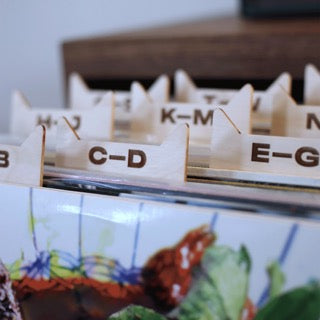
That last point is why we build the 7-inch Crate, which is sized specifically for singles rather than asking them to share space with LPs. For 12-inch records, the Milk Crate Alternative does the same job in solid wood instead of plastic, and solid wood dividers keep sections upright and easy to flip through as the collection grows. Everything we build is in the record storage collection, and if you are setting up a listening space around a turntable, the turntable stations are built for that.
Send Us Your Story
If you have a first record story, a piece you built a room around, or a find you are still bragging about, send it our way through our contact page. We publish the good ones.
Much love and happy collecting,
-Matt




Comments (0)
There are no comments for this article. Be the first one to leave a message!