

The IKEA Kallax is the default answer to vinyl storage, and for good reason. It is cheap, it is everywhere, and a 13 inch cube happens to be almost exactly the right size for a stack of LPs. Most collectors start there. Plenty of them stay there.
But "most people use it" and "it is the right tool" are different claims. Here is an honest comparison of the Kallax against a solid wood turntable station, including the places where the Kallax genuinely wins.
The quick answer
Buy a Kallax if your collection is growing fast, your budget is tight, and you file records spine-out like books. Buy a solid wood station if you flip through your records regularly, you want your turntable and your collection in one piece of furniture, and you want something that will not need replacing.
Weight is the part nobody checks
IKEA rates every Kallax shelf at a maximum load of 29 pounds, which is 13 kilograms. That number is published on IKEA's own product pages and repeated in their customer service documentation, and it applies to the unit standing vertically and anchored to the wall.
Now do the arithmetic for records. A 12 inch LP in its jacket and inner sleeve runs roughly half a pound. Heavier pressings, gatefolds, and double albums run more. A Kallax cube packed with 60 to 80 records is therefore carrying somewhere between 30 and 45 pounds.
That is at or beyond the rating, on every full cube, permanently. This is why search results are full of photos of bowed Kallax shelves, and why the standard advice in collector forums is to not fill every cube. The shelf is not defective. It is doing exactly what a 29 pound shelf does when you ask it to hold 40 pounds for three years.
A solid wood station is not carrying records on a shelf at all. The weight sits in a bin with the load path running straight down through solid sides into the legs or the floor. There is no span to sag.
Material
The Kallax is particleboard and fiberboard with a printed finish. That is not an insult, it is what IKEA publishes, and it is how they hit the price. Particleboard is dimensionally stable and perfectly fine under light loads. It does not do well under sustained heavy loads, it does not do well with moisture, and it cannot be repaired. Once a shelf bows or a corner blows out, the piece is done.
Solid hardwood behaves differently under the same conditions. It holds a load without creeping, it can be sanded and refinished, and a damaged corner can be repaired rather than replaced. Our pieces are built from Pacific Coast maple in Portland, Oregon.
How you actually browse
This is the difference that matters most day to day, and it is the one that is hardest to appreciate until you have lived with both.
A Kallax stores records spine-out, like books. To find something you read spines, tip the album out, and put it back. It works. It is also the reason most Kallax owners play the same forty records over and over: the other three hundred are invisible.
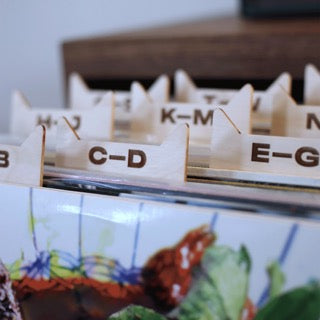
A front-facing flip bin stores records face-out, the way a record store does. You flip through covers. You see the art. You rediscover albums you forgot you owned, because the browsing itself surfaces them. Collectors who switch from shelves to bins consistently report playing more of their collection, and that is the actual point of owning records rather than streaming.
Our turntable stations put the flip bin directly beside the turntable, so you browse and drop the needle without moving.
Where the Kallax genuinely wins
Three places, and we would rather say so than pretend otherwise.
Price. Nothing handmade competes with a 2x2 Kallax on cost. If the choice is between a Kallax today and records stacked on the floor for another year, buy the Kallax.
Capacity per dollar. A 4x4 Kallax swallows a very large collection for a very small outlay. For collections in the thousands, bins get expensive fast.
Availability. You can have one this afternoon. Our build time is 4-6 weeks, because each piece is made to order by hand.
Side by side
| IKEA Kallax | Solid wood turntable station | |
|---|---|---|
| Material | Particleboard and fiberboard | Solid hardwood |
| Rated shelf load | 29 lb per shelf | No shelf span, load runs to the floor |
| Browsing | Spine-out, like books | Face-out flip bin, like a record store |
| Turntable | On top, 29 inches up on a 2x2 | Integrated, at browsing height |
| Repairable | No | Yes, sand and refinish |
| Assembly | Flat pack, self assembled | Ships fully assembled, attach legs |
| Lead time | Same day | 4-6 weeks build time |
| Cost | Low | Significantly higher |
The turntable problem
Most people set the turntable on top of the Kallax. Two issues come with that.
First, height. A 2x2 Kallax puts the platter around 30 inches up, which is fine, but a 4x4 puts it near chest height and a 1x4 laid flat puts it at 16 inches, which means kneeling to cue a record.
Second, vibration. Particleboard is light and it transmits footfall and speaker energy into the plinth, which the cartridge then reads as rumble. Mass dampens vibration. A heavy solid wood top does a measurably better job of isolating a deck than a hollow-core shelf does.
If you are going to keep the Kallax, at minimum put an isolation platform under the turntable and keep speakers off the same unit.
What we would tell you to do
If you own fewer than 150 records and you are not sure vinyl is a lifelong thing, buy a Kallax. We mean that.
If you are past 200 records, you flip through them regularly, and you have started thinking about where the turntable lives rather than just where the records go, that is the point where a station earns its cost. Start with the Tallboy if budget is the constraint, since it is the same top and the same bin without the cabinet below. Step up to The Turntable Station or the HalfStack when you want storage underneath too.
Common questions
How many records fit in a Kallax cube?
Roughly 60 to 80 twelve inch LPs, depending on jacket thickness and how tightly you pack them. At about half a pound per record that is 30 to 45 pounds, which exceeds IKEA's published 29 pound per shelf rating.
Will a Kallax shelf sag under records?
Many do over time. A fully loaded cube sits above the rated load, and particleboard creeps under sustained weight. Spreading records across more cubes rather than filling a few helps.
Can you put a turntable on top of a Kallax?
Yes, and most people do. Be aware that particleboard transmits vibration more than solid wood, and that taller units put the platter at an awkward height. An isolation platform helps.
Is front-facing storage better than shelf storage?
For browsing, yes. Face-out bins let you flip through covers the way you would at a record store, which surfaces albums you would otherwise forget. For raw capacity per dollar, shelves win.
What holds up better long term, particleboard or solid wood?
Solid wood, under heavy sustained loads. Particleboard is stable under light loads but cannot be repaired once it bows or breaks, while solid wood can be sanded, refinished, and repaired.
Still deciding?
If you want to know whether your specific turntable fits one of our tops, we measured the ten most common decks against every piece we build. See the turntable fit guide, or browse all vinyl record storage.
Much love and happy collecting,
-Matt



Comments (0)
There are no comments for this article. Be the first one to leave a message!