

How to Actually Store Your Vinyl Records (Not the Pinterest Version)
Every few months someone walks into a conversation about record storage convinced they've ruined their collection because they stacked a few LPs flat for a weekend. Deep breath. You probably haven't. But there are a handful of things that do real damage over time, and most of them have nothing to do with the fancy cabinet you're eyeing.
Here's what we've picked up after ten years of building furniture around this exact problem.
Vertical, always, but not crammed
Records need to stand up on their edge, not lie flat. Flat storage lets gravity do its slow, ugly work — the weight of the stack warps the vinyl underneath, and a warped record will never sound right again no matter what you do to it afterward. This one's not negotiable.
But vertical storage has its own failure mode: packing the shelf too tight. If you have to wrestle a record out of its slot, you're bending the sleeve, stressing the spine, and eventually cracking jackets you probably paid real money for. A good rule of thumb — you should be able to flip through a shelf with two fingers, not pry records out with your whole hand. Leave a little slack. Buy the next size up if you're between sizes.
Sunlight is the quiet killer
Nobody thinks about this until their jacket spines have gone from black to a weird faded purple-brown. UV exposure breaks down ink and cardboard over time, and vinyl itself can warp if it sits somewhere that gets genuinely hot — a west-facing window in summer is worse than people expect. If your storage furniture lives near a window, it's worth rotating things occasionally or just accepting that shelf is for the records you don't mind fading a bit.
Humidity swings matter more than humidity level
A stable damp basement is often less risky than a room that swings between bone-dry heating in winter and humid summers. Wood breathes with moisture changes, and if your shelving is built from anything other than solid wood — particleboard, MDF, thin veneer over composite — that swelling and shrinking can warp the shelf itself over a few years, not just stress your records. This is the actual reason "solid wood" gets repeated so much in this hobby. It's not about looking nicer (though it does). Solid wood moves as one piece; engineered wood delaminates and swells unevenly at the seams.
Sort however keeps you playing records, not however looks best in photos
Alphabetical by artist works for most people. Genre-first works if you build playlists by mood. Some people sort by label because they collect a particular imprint. There's no wrong answer here except one: if your system is so precise that putting a record back is annoying, you'll stop doing it, and things will end up in a pile "to be filed later" that never gets filed. Whatever system means you can put a record away in ten seconds is the right one.
A word on dividers
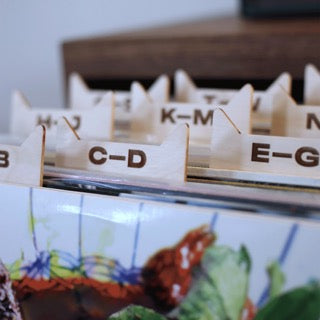
If you're not using dividers, your collection slowly leans. A few records lean, then the ones next to them lean to compensate, and eventually you've got a domino effect across an entire shelf with warped covers at the low end of the slope. Dividers every 15–20 records keep everything upright without needing to be some rigid card-catalog system.
What actually protects your investment
If you've got first pressings or anything you'd be genuinely upset to lose, the two things that matter most are keeping them off the floor (dust, moisture, the occasional spilled drink) and keeping them out of direct sun. Everything else — inner sleeve upgrades, poly outer sleeves, humidity-controlled rooms — is optimization on top of those two basics.
We build furniture for exactly this stuff, so we've got a bias here, obviously. But even if you never buy a single piece from us: get your records upright, off the floor, out of the sun, and loose enough to flip through without a fight. That's most of the battle.
— Matt & the crew at WickerWoodWorks, Portland, OR



Comments (0)
There are no comments for this article. Be the first one to leave a message!